Sunday, May 17, 2009

In The U.S.A. ~ SAFE Act: Abuse Industry Batters the Truth


By Carey Roberts

May 15, 2009


http://mensnewsdaily.com/2009/05/15/safe-act-abuse-industry-batters-the-truth/


There is a group of activists among us who have found the perfect way to advance their statist, anti-family agenda. They ply their issue by relying on a devious mixture of exaggerations, half-truths, and bald-faced lies.


I’m referring, of course, to the domestic violence industry. DV operatives make bogus claims designed to garner ever-expanding federal funding, which in turn is used to disseminate more biased factoids that keep women in a continuous state of fear. It’s a multi-billion dollar, taxpayer-financed scam, and I’m here to blow the whistle.


Last week Dear Abby devoted her column to helping a man who had been pummeled and maimed by his wife: www.uexpress.com/dearabby/?uc_full_date=20090506 .(ed note: also see below) And according to a 2006 Harris poll, 55% of Americans know of a man who has been physically abused by his wife or girlfriend.


But the domestic violence industry works day and night to make you think the Roper poll got it wrong — that abused men are a statistical rarity, and such men probably had it coming anyway.


Here’s the latest example of the abuse industry’s ms.-information: the Security and Financial Empowerment (SAFE) Act. The bill was recently introduced in Congress by representatives Lucille Roybal-Allard of California and Ted Poe of Texas. (The fact that Poe is a Republican shows how far the GOP has wandered from its core principles of late.)


The bill contains 33 findings – supposedly a series of verifiable facts that everyone can agree are true. But this time around, someone got very creative with the truth.


Last month RADAR, a Maryland-based watchdog group, released its analysis of the SAFE Act findings. I’ll give you fair warning, this one’s a doozy: www.mediaradar.org/docs/RADARanalysis-HR739Findings.pdf


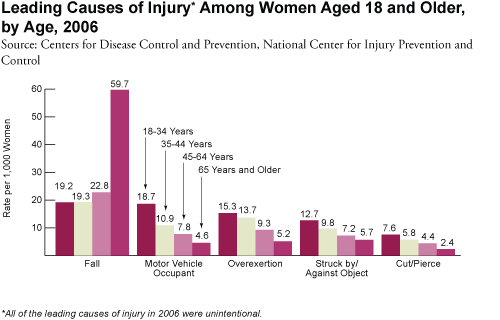
The SAFE Act starts off with this chestnut: “Violence against women has been reported to be the leading cause of injury to women.” That’s a prime example of crackpot science. Because according to the U.S. Department of Health and Human Services, the leading causes of injury to women are unintentional falls, automobile accidents, and over-exertion.


The SAFE Act goes on to assert, “According to recent Government estimates, approximately 987,400 rapes occur annually in the United States.” Want to know the real number? Only 90,427, according to the FBI.


The SAFE Act wants us to believe that “each year there are 5,300,000 non-fatal violent victimizations committed by intimate partners against women.” That claim reminds us of the old Yiddish proverb about a half-truth being a whole lie. Because the same survey that reached the 5.3 million number reported a similar number of male victims of physical abuse.


For several of its claims, the SAFE Act cites research by Joan Zorza. Problem is, Zorza is not a researcher. She’s a lawyer and well-known advocate for an assortment of radical feminist causes.

All in all, only 4 of the SAFE Act findings are accurate, up-to-date, and verifiable. All the rest are vague, misleading, exaggerated, or even intentionally deceptive.


There’s a lot more that’s wrong with the SAFE Act, including the fact that it will open the floodgates to even more false allegations of abuse (www.renewamerica.us/columns/roberts/090204) and impose a gigantic unfunded liability on American businesses (www.renewamerica.us/columns/roberts/090209 ).


So why did representatives Roybal-Allard and Poe risk bringing dishonor upon themselves by sponsoring this piece of legislative clap trap?


WIFE'S BRUTAL SENSE OF HUMOR LEAVES ITS MARK ON MARRIAGE


DEAR ABBY: My wife thinks it's funny when she hits me. The other day I was splitting some wood and decided to take a break. I began driving golf balls into the field. She came out, grabbed the club out of my hands and whacked me in the leg with it. When I asked her why, she said, "Get back to work!" and started laughing. I was left with a large welt and a big bruise.

Another time she bought some king crab legs for dinner. When I asked her if she was serving anything else with them, she picked up a crab claw and hit me in the forehead with it. She thought it was funny. I ended up in the emergency room with three stitches.

Last night, I was trying to add up our bills on the computer. She walked in and smacked me in the chin with the keyboard. She said I should be able to do the bills on paper like a normal person.

We have been together nine years, married for three. I love her with all my heart, but I'm getting tired of her little "jokes." How can I approach her? I want her to know how I feel, but I'm afraid to offend her or make her angry. -- FRUSTRATED IN OREGON

DEAR FRUSTRATED: Why are you afraid to speak your mind? Are you afraid she'll hit you again? Your wife has a sadistic sense of humor and enjoys seeing you in pain. Unless you draw the line, she will cause you serious injury.

Regardless of how much you love her, for your own safety you should get the heck out of there. What you have described is a form of spousal abuse, and it will escalate. That's why I'm urging you to contact the National Domestic Violence Hotline. The toll-free number is (800) 799-7233. The counselors there offer guidance to women AND men who are being abused by their spouse or partner.

Another organization, SAFE (Stop Abuse for Everyone), also assists victims of abuse regardless of age, gender or sexual orientation. Its Web site is www.safe4all.org.

Saturday, May 16, 2009

Social chaos awaits unless Parliament restores restraint

This a is an interesting commentary on the damage done by No Fault Divorce. I certainly support the notion of putting it out of its misery. Its an obvious ticket for wives to walk away with lots of entitlements and they do in 75% of divorce contests as the applicant. The problem is the greener pastures they thought were out there by instigating the divorce aren't in most cases and they end up putting the children they receive "ownership" of by the feministically sensitized judiciary in almost 90% of cases into poverty. In other words the best interest of the children are not met. There are about 27 million fatherless children in North America in 2009 and a myriad of social problems due to judicial social engineering. There are also over 50,000,000 dead children through abortion since the early 70's in North America not including Mexico.MJM


By RORY LEISHMAN, LONDON FREELANCE WRITER

Thursday marked the 40th anniversary of the passage through Parliament of the most calamitous legislation in Canadian history -- an omnibus set of amendments to the Criminal Code introduced by former prime minister Pierre Trudeau that included easier divorce proceedings as well as legalized abortion and the sale of contraceptives.

With rare exceptions prior to 1969, divorce could only be obtained on the proven grounds of adultery. By expanding those grounds to include marital breakdown, Trudeau's omnibus bill cleared the way for a sharp increase in divorces. By 1986, the year before Parliament introduced absolutely no-fault divorce, the national divorce rate was more than 10 times higher than 50 years earlier.

During this period, there has been a sharp rise in the number of lone-parent families in Canada, most of them headed by women. And according to Statistics Canada, the low-income rate for female lone-parent families is four times greater than the average for all families.

Children, of course, are the primary victims of divorce. Study after study confirms that youngsters who grow up without the care and guidance of their natural father are far more likely to live in poverty, suffer from sexual abuse, obtain poor grades in school, end up in trouble with the law and eventually get divorced.

How long will it take for most Canadians to grasp the ruinous consequences of the experiment with no-fault divorce initiated by Trudeau? When will Parliament reform the divorce act to penalize a cruel and selfish parent who for no good reason, breaks up the family home?

In 1969, a few hardy souls warned that legalizing the sale of contraceptives would contribute to a disastrous increase in fornication, adultery and abortion as well as an epidemic of sexually transmitted diseases and other untold miseries for sexually promiscuous people.

Today, of course, any attempt to reinstate constrictions on the sale of contraceptives is out of the question. Canadians are fated to suffer the consequences of this aspect of Trudeau's ill-considered reforms for generations to come.

What, though, about the legalization of abortion? Prior to Trudeau's bill, the deliberate procurement of abortion was a criminal offence in Canadian law punishable by up to life imprisonment.

Supporters of legalized abortion in 1969 claimed that as many as 300,000 Canadian women were annually forced to undergo illegal abortions, most of them in dangerous backroom conditions. That figure was preposterous. And so was the assurance by Trudeau's justice minister, John Turner, during debate on the omnibus bill that its provision for legalizing abortion does not promote abortion.

According to Statistics Canada, there were 11,200 abortions in Canada in 1970, the year Trudeau's bill came into effect. By 1987, that figure had risen to 67,343.

In the 1988 Morgentaler ruling, the Supreme Court of Canada abolished even the few remaining restrictions on abortion in the Criminal Code. And within four years of this calamitous exercise in judicial activism, the annual death toll from induced abortion exceeded 100,000. Altogether, some 3.5 million babies have been deliberately killed by abortion in Canada since 1969.

Now, many of the people who applauded the legalization of abortion in 1969 are beginning to worry about the aging of the Canadian population. No conceivable amount of immigration can reverse this trend. Statistics Canada projects that by 2026, one Canadian in five will be aged 65 or over, up from fewer than one in 10 in 1981.

Who will pay for the crushing costs of health care in 2026? Who will finance soaring expenditures for unfunded Canada Pension Plan and Old Age Security liabilities in the next 20 to 30 years?

Trudeau's misconceived reforms to the Criminal Code have truly had a calamitous impact. There is no more urgent priority for Parliament than to restore some prudent restraints on abortion, divorce and family breakdown. Failure to do so will foster social chaos and undermine the security of Canada as a parliamentary democracy with a recognizable heritage of freedom under law.

More parents share the workload when mom learns to let go

USA Today has recognized gatekeeping by mothers. Perhaps now it will be recognized better how many mothers drive their husbands away from helping more with the children, among other things, and then they complain how little help he is. Compare this kind of gatekeeping occurring within intact families and then visualize how it gets magnified in separation and divorce. Its all about the same thing "ownership."MJM


By Sharon Jayson, USA TODAY

Equality is gaining ground at homes across the USA, but the move toward parity leaves some mothers in a quandary; they're ready to share the workload with their partners, but to do that, they'll also have to come to terms with the loss of hierarchy at home.

"Women who want to create this sometimes don't appreciate the level at which they must let go," says Amy Vachon of Watertown, Mass. She and her husband, Marc, have become the standard-bearers for a philosophy called "equally shared parenting."

"It's not so much the stereotypical 'Let my husband dress the kids in things that don't match' — that's the surface, easy stuff. It's more the deep-down letting go — being just fine when your child runs to your husband instead of you when she falls down on the playground," she says. "My first reaction is, 'I hope the other mothers didn't notice because maybe they would judge me.' "

The idea that Mother Knows Best for all things home and family is deeply ingrained and complicated by gender roles, socialization and culture, experts say. And now new research is beginning to help make sense of that maternal angst.

"There are a lot of pressures that keep reinforcing the division of responsibility in parenting that leaves moms in the control position — the 'expert parent' role," says demographer Catherine Kenney of Bowling Green State University in Bowling Green, Ohio, who has studied how mothers' beliefs affect fathers' involvement.

New research into the idea of "maternal gatekeeping" shows how attitudes and actions by the mother may promote or impede father involvement.

"For women who insist they have the gold standard around parenting and housework, men just tend to walk away," says Joshua Coleman, a clinical psychologist in San Francisco and Oakland. "They feel their own ideas about how the house should look or … how the children should be raised aren't given equal share."

Kenney presented research she co-wrote at a meeting of the Population Association of America over the weekend. The study of 1,023 couples from 20 large cities in the USA found mothers were protective of their caregiving and educational engagement with the child but were less so for playtime activities that "were not considered threats to the mother's caregiving identity," the paper says.

"Maybe he's not more involved because mom is holding him back," Kenney says.

Through interviews at the child's birth and at ages 1, 3 and 5, mothers and fathers reported about their own parenting expectations and beliefs as well as the time personally spent in various caregiving activities.

Dad needs woman's support

Other gatekeeping research co-written by Sarah Schoppe-Sullivan, an assistant professor of child development at Ohio State University in Columbus, is significant because it studied actual behaviors rather than just beliefs, and of the 97 couples participating, fathers were more involved in daily care of infants when they received active encouragement from the wife or partner.

"This study provides perhaps the best evidence to date that the phenomenon of maternal gatekeeping exists and that, under some conditions, it may have the potential to affect fathering behavior," says the study, published last year in the Journal of Family Psychology.

Corinna Buchholz, 34, of Portland, Ore., says "gatekeeping is real because you love your child so much and want to say, 'Wait, do it this way.' I try very hard not to because it's somewhat counterproductive."

At the Shippensburg, Pa., home of Catherine Zobal Dent, 37, and Silas Dent Zobal, 35, equality has reached a greater level of sharing.

Both are college English professors who recently left their respective campuses and will share one tenure-track faculty position this fall at Susquehanna University, about 80 miles away. They have a son, Emerson Dent Zobal, 3. A daughter, whom they plan to name Lake Zobal Dent, is due in two weeks.

"My mom strongly identified with the feminist movement," Silas says, explaining a fairness mentality that sometimes even surprises his wife.

Says Catherine: "I have this image in my head of my mother preparing and serving the food and my father being the social conductor. When Silas and I are entertaining colleagues or friends, sometimes I find myself wanting to revert to that position. I'll stand up to clear the table and think it's OK if he continues to sit, but he doesn't. He stands up, too."

Other names for the same approach include "co-parenting," "peer parenting" or "shared care," but the concept "equally shared parenting" the Vachons adopted was first suggested 10 years ago in a book by psychologist Francine M. Deutsch called Halving It All: How Equally Shared Parenting Works.

They've created a website, equallysharedparenting.com. Their book, Equally Shared Parenting: Rewriting the Rules for a New Generation of Parents, will be published in January.

Not 'just a hired hand'

"There are those that absolutely want equally shared parenting. They want a true equal partner who wants an equivalent say," Amy Vachon says. "But I also hear a huge group of people focused on these task divisions. They want a better helper at home, and that is not equally shared parenting."

The Vachons are both 46, and each works outside the home 32 hours a week. She's a clinical pharmacist. He works in information technology for a market research firm. They have two children, Maia, 6, and Theo, 3.

"I want to be an equal partner here," Marc Vachon says, not "just a hired hand."

He says planning a birthday party for their daughter starts with his wife's list of what has to be done — to which he agrees or disputes — before they decide how to divvy up the jobs.

"I don't want to be nagged or reminded," he says. "If I'm watching TV or going to play tennis, she has to trust me as a person living up to my responsibility. I'll get things done. She does not need to worry about it."

That's not what happens in many homes, says Andrea O'Reilly, associate professor of women's studies and director of the Association for Research on Mothering at York University-Toronto.

"She might delegate to her partner, but if you have to do the remembering and the organizing, the planning and the worrying, that's not equality," she says. "The intellectual labor of running a household — that work is still done predominantly by women."

Sampson Lee Blair, an associate professor of sociology at the University at Buffalo, studies division of labor in families. He says decades of research have found a "very sharp gender divide of 'his work' vs. 'her work.' "

For the same-sex couple

Negotiating roles is somewhat different in same-sex couples, says Esther Rothblum, a women's studies professor at San Diego State University.

"It's unusual in same-sex couples that one person does everything and the other person does nothing," she says.

Psychotherapist Anne Coyle, 45, of El Cerrito, Calif., says she and her partner of almost 16 years have "divided it more like a traditional, heterosexual couple" as they parent a son, age 8.

"I pick up Isaac and tend to do more of the cooking and cleaning, whereas Linda tends to work more and bring in more of the income. We're choosing that, and it's each of our preferences," she says.

Schoppe-Sullivan, 34, says that although she and her husband try to share parenting of their 3-year-old equally, she understands what mothers have at stake.

"I have certainly felt ambivalent about relinquishing control over what my daughter wears or eats. There are times when my husband dresses her in an outfit and I think, 'What is he doing?' I try to bite my tongue," she says. "The way your children look, a lot of mothers feel like it reflects on them.

"The way I would describe it is, in the end, society is still not going to come down on the father," she says. "Society is going to come down on you."

READERS: How do you and your spouse split parenting duties?


Links referenced within this article

Family life, roles changing as couples seek balance
http://www.usatoday.com/news/health/2009-04-18-families-conf_N.htm
Can we be married but independent?
http://www.usatoday.com/news/health/2009-04-14-marriage-cherlin-QnA_N.htm


Find this article at:
http://www.usatoday.com/news/health/2009-05-04-equal-parenting_N.htm

Thursday, May 14, 2009

Females are more than equal in the Federal and Ontario Public Service

Some interesting stats from the Ontario Public Sector which is currently rapidly approaching a 60% female demographic, which of course means men are a minority of 40% of the employees.

In the Federal Public Service have a look at the numbers from the

Sixteenth Annual Report to the Prime Minister on the Public Service of Canada

Public Service Diversity
a) Gender
"The reversal in gender representation over the past 25 years remains one of the most significant changes in the public service.
In 2008, women represent 54.9% of public servants (compared with 42% in 1983)."


Since 1998 - 10 years ago - women have been the majority population in the Federal Government.

The gender feminists won't be happy with this though, (are they ever) because they will whine about the top jobs being controlled by men. Affirmative action has been in place since the 70's and they have no one to blame but themselves if they can't get the top jobs on merit.

Demographic Profile of the Public Service of Canada
(March 31, 2008)
  • 263,000 employees (251,000 in 1983)
  • 54.9% women (42% in 1983)
  • 41.2% of executives are women (less than 5% in 1983)
  • 60.1% of employees in the regions and 39.9% in the National Capital Region
  • 85.5% indeterminate employees; 9.5% term employees; 5% casuals and students
  • 70.6% declare English their first official language; 29.4% declare French
  • Average age 44 years (39 in 1983)
  • Average age of executives 50.4 years (48.7 in 1983)
  • Public service represents 0.8% of the Canadian population (1% in 1983)


Build bridges to resume contact

from Mike Murphy
sender timeSent at 10:42 (GMT-04:00). Current time there: 10:43.
reply-to
tobarbaraburrows@cogeco.ca
date14 May 2009 10:42
subjectColumn re : Build bridges to resume contact
mailed-bygmail.com


Ms. Burrows. I made the following comments on my blog dealing with Parental Alienation with respect to your advice re : Build bridges to resume contact


We have here a professional psychotherapist offering excuses for an abusive parent. Political correctness knows no bounds. If it had been a dad doing the alienating one could be certain Ms. Burrows wouldn't be saying "he's protective". As long as people like her are providing these kinds of answers we'll still have lots of enablers of child abuse, particularly mothers, who seem to be able to get away with pretty much anything under the guise of "protection." Also note Burrows was of absolutely no help to the Grandmother but made lots of effort to defend the mother's actions. Most of these therapists know, abuse not being a factor, and in this case how could it be, alienating parents have a high probability of mental health disorders.

Its a shame because the main victim is the child first and all of the dads extended family. What would she say if the complaint was about physical bruising rather than psychic bruising. Yes, call the Child Protection Agency and the Police. Its a disappointment these so-called professionals still try to cover up this abuse.

Mike Murphy


Special to The Windsor Star

Barbara Burrows

Dear Barbara: I've been following the discussion on PAS (Parental Alienation Syndrome) and would like to tell you about my son's child - who is forbidden access to his father by the mother - a women my son was never married to. I know of others with similar situations.

For awhile, I was on good terms with the mother who allowed the boy to come to spend two days/week with me and he had a good relationship with me and my daughter.

My son is a good person, gainfully employed, pays child support and has friends. It breaks our hearts that he can't see his son.

At one point, I told the mother that it wasn't right that she not let the child see his father and the boy's time with me ended - in fact - she called the police.

My husband and I have sent e-mails, cards for special occasions etc. - but there is no response at all.

There are a whole group of children who are suffering because one parent has control and keeps the child from the other. Grandparents have no rights in Ontario.

I realize that this is not a black and white issue, but as desperate as the parents are, it is the children who need help.

Have you any suggestions?

Dear Grandmother: You must be feeling very helpless.

What comes to my mind is that there was a time that your grandson's mother felt comfortable enough to let you spend time with him.

My thinking is that you may be able to rekindle that positive connection if you can figure out how you were able to establish it in the first place. My guess is that you somehow were able to put aside your hurt, critical feeling and likely anger towards the boy's mother and maintain some neutral, low-key civility.

Mothers are usually intensely protective of their children and this is where situations can get out of hand. For some reason, they become extra sensitive and perceive that the father is a negative influence.

I suppose it is possible that parents intentionally withhold the children to punish the other, but my experience has been the withholding parent truly believes it is in the child's best interest - in fact - that the child needs protecting from something in the other parent. This is often a distortion - but the overprotective parent cannot see it.

This mother will never see your son as you do - simply accept that - and see what you might need to do to secure her trust so that you may have an opportunity to continue to build a relationship with the boy.

I believe you will have to call her directly and say you are missing the boy very much and ask if you could please come and talk with her.

You need to find a way to find out what has upset her and see how this can be resolved so you can resume your relationship with this child. Perhaps inviting her out for lunch or coffee - into neutral territory might help the discussion.

If you can build a bridge to your family, the chances of your son connecting with his son will be much greater.

Barbara Burrows is a psychotherapist who works with a group of professional advisers to address the questions sent to her by concerned parents. Her column appears Thursdays. Questions or comments can be sent to barbaraburrows@cogeco.ca. Visit her website www.barbaraburrows.com

© The Windsor Star 2009

Wednesday, May 13, 2009

The real cause of Injury to women rather than the Radical Feminist Propaganda of Domestic Violence.


From: Information on this page can be found in the print version of Women's Health USA 2008. Suggested Citation: U.S. Department of Health and Human Services, Health Resources and Services Administration, Maternal and Child Health Bureau. Women's Health USA 2008. Rockville, Maryland:

Injury

Often, injuries can be controlled by either preventing an event (such as a car crash) or lessening its impact. This can occur through education, engineering and design of safety products, enactment and enforcement of policies and laws, economic incentives, and improvements in emergency care. Some examples include the design, oversight, and use of child safety seats and seatbelts, workplace regulations regarding safety practices, and tax incentives for fitting home pools with fences.

In 2006, unintentional falls were the leading cause of nonfatal injury among women of every age group, and rates generally increased with age. Women aged 65 years and older had the highest rate of injury due to unintentional falls (59.7 per 1,000 women), while slightly more than 19 per 1,000 women aged 18–34 and 35–44 years experienced fall-related injuries. Unintentional injuries sustained as motor vehicle occupants were the second leading cause of injury among 18- to 34-year-olds (18.7 per 1,000), while unintentional overexertion was the second leading cause of injury among women aged 35–44 and 45–64 years (13.7 and 9.3 per 1,000, respectively). Among women aged 65 years and older, being unintentionally struck by or against an object was the second leading cause of injury (5.7 per 1,000).

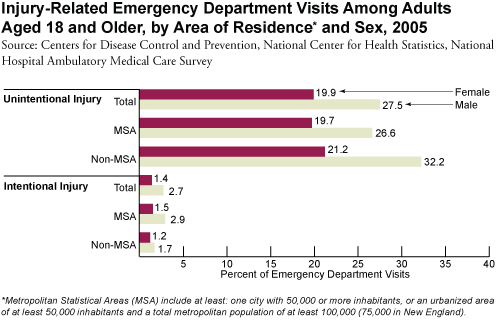
Unintentional and intentional injuries each represented a higher proportion of emergency department (ED) visits for men than women in 2005. Among women and men aged 18 years and older, unintentional injuries accounted for 19.9 and 27.5 percent of ED visits, respectively, while intentional injuries, or assault, represented 1.4 and 2.7 percent of visits, respectively. Among both women and men, unintentional injury accounted for a higher percentage of ED visits among those living in non-metropolitan areas, while adults living in metropolitan areas had a slightly higher percentage of ED visits due to intentional injury.

Leading Causes of Injury Among Women Aged 18 and Older, by Age, 2006 [D] Injury-Related Emergency Department Visits Among Adults Aged 18 and Older, by Area of Residence and Sex, 2005