| |||||
| Articles & Commentary Persistent Myths in Feminist Scholarship By Christina Hoff Sommers Chronicle of Higher Education Monday, June 29, 2009
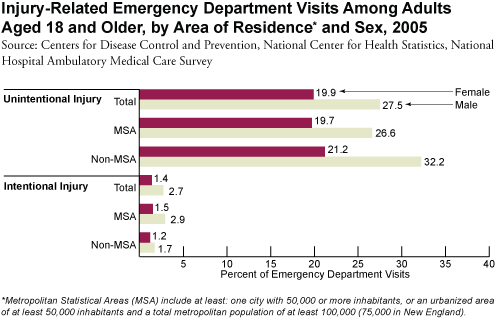
"Harder to kill than a vampire." That is what the sociologist Joel Best calls a bad statistic. But, as I have discovered over the years, among false statistics the hardest of all to slay are those promoted by feminist professors. Consider what happened recently when I sent an e-mail message to the Berkeley law professor Nancy K. D. Lemon pointing out that the highly praised textbook that she edited, Domestic Violence Law (second edition, Thomson/West, 2005), contained errors. Her reply began: "I appreciate and share your concern for veracity in all of our scholarship. However, I would expect a colleague who is genuinely concerned about such matters to contact me directly and give me a chance to respond before launching a public attack on me and my work, and then contacting me after the fact." The critical work of 21st-century feminism will be to help women in the developing world, especially in Muslim societies, in their struggle for basic rights. I confess: I had indeed publicly criticized Lemon's book, in campus lectures and in a post on FeministLawProfessors.com. I had always thought that that was the usual practice of intellectual argument. Disagreement is aired, error corrected, truth affirmed. Indeed, I was moved to write to her because of the deep consternation of law students who had attended my lectures: If authoritative textbooks contain errors, how are students to know whether they are being educated or indoctrinated? Lemon's book has been in law-school classrooms for years. One reason that feminist scholarship contains hard-to-kill falsehoods is that reasonable, evidence-backed criticism is regarded as a personal attack. Lemon's Domestic Violence Law is organized as a conventional law-school casebook--a collection of judicial opinions, statutes, and articles selected, edited, and commented upon by the author. The first selection, written by Cheryl Ward Smith (no institutional affiliation is given), offers students a historical perspective on domestic-violence law. According to Ward: "The history of women's abuse began over 2,700 years ago in the year 753 BC. It was during the reign of Romulus of Rome that wife abuse was accepted and condoned under the Laws of Chastisement. . . . The laws permitted a man to beat his wife with a rod or switch so long as its circumference was no greater than the girth of the base of the man's right thumb. The law became commonly know as 'The Rule of Thumb.' These laws established a tradition which was perpetuated in English Common Law in most of Europe." Where to begin? How about with the fact that Romulus of Rome never existed. He is a figure in Roman mythology--the son of Mars, nursed by a wolf. Problem 2: The phrase "rule of thumb" did not originate with any law about wife beating, nor has anyone ever been able to locate any such law. It is now widely regarded as a myth, even among feminist professors. A few pages later, in a selection by Joan Zorza, a domestic-violence expert, students read, "The March of Dimes found that women battered during pregnancy have more than twice the rate of miscarriages and give birth to more babies with more defects than women who may suffer from any immunizable illness or disease." Not true. When I recently read Zorza's assertion to Richard P. Leavitt, director of science information at the March of Dimes, he replied, "That is a total error on the part of the author. There was no such study." The myth started in the early 1990s, he explained, and resurfaces every few years. Zorza also informs readers that "between 20 and 35 percent of women seeking medical care in emergency rooms in America are there because of domestic violence." Studies by the federal Centers for Disease Control and Prevention and the Bureau of Justice Statistics, an agency of the U.S. Department of Justice, indicate that the figure is closer to 1 percent. Few students would guess that the Lemon book is anything less than reliable. The University of California at Berkeley's online faculty profile of Lemon hails it as the "premiere" text of the genre. It is part of a leading casebook series, published by Thomson/West, whose board of academic advisers, prominently listed next to the title page, includes many eminent law professors. I mentioned these problems in my message to Lemon. She replied: "I have looked into your assertions and requested documentation from Joan Zorza regarding the March of Dimes study and the statistics on battered women in emergency rooms. She provided both of these promptly." If that's the case, Zorza and Lemon might share their documentation with Leavitt, of the March of Dimes, who is emphatic that it does not exist. They might also contact the Centers for Disease Control statistician Janey Hsiao, who wrote to me that "among ED [Emergency Department] visits made by females, the percent of having physical abuse by spouse or partner is 0.02 percent in 2003 and 0.01 percent in 2005." Here is what Lemon says about Cheryl Ward Smith's essay on Romulus and the rule of thumb: "I made a few minor editorial changes in the Smith piece so that it is more accurate. However, overall it appeared to be correct." A few minor editorial changes? Students deserve better. So do women victimized by violence. Feminist misinformation is pervasive. In their eye-opening book, Professing Feminism: Education and Indoctrination in Women's Studies (Lexington Books, 2003), the professors Daphne Patai and Noretta Koertge describe the "sea of propaganda" that overwhelms the contemporary feminist classroom. The formidable Christine Rosen (formerly Stolba), in her 2002 report on the five leading women's-studies textbooks, found them rife with falsehoods, half-truths, and "deliberately misleading sisterly sophistries." Are there serious scholars in women's studies? Yes, of course. Sarah Blaffer Hrdy, an anthropologist at the University of California at Davis; Janet Zollinger Giele, a sociologist at Brandeis; and Anne Mellor, a literary scholar at UCLA, to name just three, are models of academic excellence and integrity. But they are the exception. Lemon's book typifies the departmental mind-set. Consider The Penguin Atlas of Women in the World (2008), by the feminist scholar Joni Seager, chair of the Hunter College geography department. Now in its fourth edition, Seager's atlas was named "reference book of the year" by the American Library Association when it was published. "Nobody should be without this book," says the feminist icon Gloria Steinem. "A wealth of fascinating information," enthuses The Washington Post. Fascinating, maybe. But the information is misleading and, at least in one instance, flat-out false. One color-coded map illustrates how women are kept "in their place" by restrictions on their mobility, dress, and behavior. Somehow the United States comes out looking as bad in this respect as Somalia, Uganda, Yemen, Niger, and Libya. All are coded with the same shade of green to indicate places where "patriarchal assumptions" operate in "potent combination with fundamentalist religious interpretations." Seager's logic? She notes that in parts of Uganda, a man can claim an unmarried woman as his wife by raping her. The United States gets the same low rating on Seager's charts because, she notes, "State legislators enacted 301 anti-abortion measures between 1995 and 2001." Never mind that the Ugandan practice is barbaric, that U.S. abortion law is exceptionally liberal among the nations of the world, and that the activism and controversy surrounding the issue of abortion in the United States is a sign of a vigorous free democracy working out its disagreements. On another map, the United States gets the same rating for domestic violence as Uganda and Haiti. Seager backs up that verdict with that erroneous and ubiquitous emergency-room factoid: "22 percent-35 percent of women who visit a hospital emergency room do so because of domestic violence." The critical work of 21st-century feminism will be to help women in the developing world, especially in Muslim societies, in their struggle for basic rights. False depictions of the United States as an oppressive "patriarchy" are a ludicrous distraction. If American women are as oppressed as Ugandan women, then American feminists would be right to focus on their domestic travails and let the Ugandan women fend for themselves. All books have mistakes, so why pick on the feminists? My complaint with feminist research is not so much that the authors make mistakes; it is that the mistakes are impervious to reasoned criticism. They do not get corrected. The authors are passionately committed to the proposition that American women are oppressed and under siege. The scholars seize and hold on for dear life to any piece of data that appears to corroborate their dire worldview. At the same time, any critic who attempts to correct the false assumptions is dismissed as a backlasher and an anti-feminist crank. Why should it matter if a large number of professors think and say a lot of foolish and intemperate things? Here are three reasons to be concerned: 1) False assertions, hyperbole, and crying wolf undermine the credibility and effectiveness of feminism. The United States, and the world, would greatly benefit from an intellectually responsible, reality-based women's movement. 2) Over the years, the feminist fictions have made their way into public policy. They travel from the women's-studies textbooks to women's advocacy groups and then into news stories. Soon after, they are cited by concerned political leaders. President Obama recently issued an executive order establishing a White House Council on Women and Girls. As he explained, "The purpose of this council is to ensure that American women and girls are treated fairly in all matters of public policy." He and Congress are also poised to use the celebrated Title IX gender-equity law to counter discrimination not only in college athletics but also in college math and science programs, where, it is alleged, women face a "chilly climate." The president and members of Congress can cite decades of women's-studies scholarship that presents women as the have-nots of our society. Never mind that this is largely no longer true. Nearly every fact that could be marshaled to justify the formation of the White House Council on Women and Girls or the new focus of Title IX application was shaped by scholarly merchants of hype like Professors Lemon and Seager. 3) Finally, as a philosophy professor of almost 20 years, and as someone who respects rationality, objective scholarship, and intellectual integrity, I find it altogether unacceptable for distinguished university professors and prestigious publishers to disseminate falsehoods. It is offensive in itself, even without considering the harmful consequences. Obduracy in the face of reasonable criticism may be inevitable in some realms, such as partisan politics, but in academe it is an abuse of the privileges of professorship. "Thug," "parasite," "dangerous," a "female impersonator"--those are some of the labels applied to me when I exposed specious feminist statistics in my 1994 book Who Stole Feminism? (Come to think of it, none of my critics contacted me directly with their concerns before launching their public attacks.) According to Susan Friedman, of the University of Wisconsin at Madison, "Sommers' diachronic discourse is easily unveiled as synchronic discourse in drag. . . . She practices . . . metonymic historiography." That one hurt! But my views, as well as my metonymic historiography, are always open to correction. So I'll continue to follow the work of the academic feminists--to criticize it when it is wrong, and to learn from it when it is right. Christina Hoff Sommers is a resident scholar at AEI. | |||||


-