Tuesday, February 9, 2010

Police Chief Faulkner in London Ontario is eating his words again

I find it interesting, nay astounding, to learn the myopic Police Chief Faulkner, who would falsify his own statistics, could be viewed as a sterling citizen. He appears to have been very involved in his community but if he would commit fraud because of ideology in one major area of his service to the citizens how many others are there? Ideologues, as we have seen within Victim Feminism, will lie, cheat, commit fraud and teach our children it is a truth in many aspects of gender relationships and noncommittal behaviour.

Maybe later more of his handiwork will arise when he is gone.MJM


Politics unlikely fit for Faulkner

Last Updated: 5th February 2010, 5:01pm

With the retirement of 57-year- old London police Chief Murray Faulkner set to take effect this summer, glowing tributes to his character and record are pouring forth from many quarters.

A grad of Sir Wilfrid Laurier secondary school and Fanshawe College, Faulkner is well liked by his colleagues in the London Police Service where he was first appointed as a constable in 1975, rising to the post of deputy chief in 2000 and filling the top spot four years later.

Fellow officers always like it when one of their own heads up the service and this was doubly true when Faulkner was appointed as he followed in the wake of the dispiriting Al Gramolini debacle when an 'imported' chief was caught fiddling his expense reports and was forced to step down.

Faulkner has been a tireless ambassador to the larger community, serving on many charitable and philanthropic boards and councils and chairing the 2007 United Way campaign for London and Middlesex County. So extensive are his community commitments that it is estimated he presides at a mind-boggling 300 functions a year. This makes it more than understandable that his only stated plans for his retirement are to decompress and spend more time with his family and friends.

Faulkner is still young enough and his community standing is prominent enough that it is felt he would be a shoo-in for some sort of political office should he wish to stand as a candidate. He has not yet indicated any particular interest that way but overtures are being made to him, and he hasn't rejected the prospect out of hand.

While it might seem a natural enough progression for him to move into the political arena, such a repositioning would call on a markedly different skill set than that which he currently employs. In many ways, it would represent an inversion of the London police motto which he has sought to fulfil for the last 35 years. He would shift from a life of "Deeds not words" to one of "Words not deeds". Words are a politician's currency and tools and as a politician, Faulkner would have to exercise a level of nuance and care with his every utterance unlike anything he's ever had to concern himself with as a cop.

An example of the kind of thing I mean can be found in his address to the crowd attending the October 2006 launch of a special police task force aimed at "combatting woman abuse." At that event, Faulkner flatly identified domestic violence solely as a "gender problem," saying, "Men, and what it is to be a man in our society, (are) the problem."

This was strongly, even recklessly worded, and eight months later Faulkner's simplistic, one-sided reading of such a complicated, and fully human (i.e., pertaining to both men and women) problem, blew up in his face when London police service Insp. Kelly Johnson shot and killed retired London police superintendent David Lucio (then killed herself) the day after Lucio called off their three-year love affair to return to his wife and family.

As Ontario's Domestic Violence Death Review Committee defines domestic violence as a homicide by a partner or ex-partner, Johnson's despicable act clearly fits the bill. However unusual or flukish that situation may have been, the rage of Kelly Johnson showed that the roots of domestic violence are not solely grounded in the issue of "men, and what it is to be a man in our society."
Did Faulkner learn from this tragic act perpetrated by one of his officers, and take that opportunity to expand his understanding of domestic violence? He did not. The investigators' report on the murder-suicide which Faulkner called for, while brief, listed all kinds of extenuating circumstances that aggravated Johnson's hold on reality.

"Emotional disturbances," were cited, as well as, "historical stressors," the 2005 deaths of her mother as well as "her pet of 15 years." Such stuff would never have been considered if it had been a man who'd been pulling the trigger. More incredible still, in the release of 2007's police statistics on domestic violence (DV) perpetrated that year, only one homicide of a woman by a man was listed for the entire year. The Johnson/Lucio murder-suicide didn't make the cut.

Herman Goodden is a London freelance writer. E-mail herman.goodden@sympatico.ca

Dr. Richard Warshak ~ Tough love from Texas

This visit by Dr. Warshak indicates progress is being made within the judiciary. In one report it was stated about 130 Judges attended his seminar. The comments by The Honorable Justice John Gomery of Canada in 1991 present a vivid reminder on the passage of time before cases of Parental Alienation of a child can be identified and dealt with in an expeditious manner    “Hatred is not an emotion that comes naturally to a child. It has to be taught. A parent who would teach a child to hate the other parent represents a grave and persistent danger to the mental and emotional health of that child.”

He was a wise member of the Bench to have not overlooked the emotional abuse of the children in this Quebec case. Hopefully the judiciary will start taking the matter with the seriousness it deserves and keep the same judge involved through court proceedings and also divest themselves of the argument only recalcitrant parents take matters to litigation.

When PA is involved it is often because the alienator themselves have personality disorders and use the children as pawns.MJM


Logo

TARA WALTON/TORONTO STAR
Psychologist Richard Warshak offers intensive and controversial programs to help children who have suffered parental alienation during divorce. “Love your kids more than you hate your ex-spouse,” he says.


February 09, 2010
Susan Pigg
Living Reporter


When Richard Warshak whisked into Toronto last week from his native Texas, he brought along some tough-love advice for both divorcing parents and family court judges.

"Love your kids more than you hate your ex-spouse," the renowned expert on parental alienation said.

Be firm and fast at pushing toxic custody cases through the clogged courts, he advised judges attending a day-long seminar at the Four Seasons Hotel.

The psychologist runs the controversial Family Bridges, a Texas-based "educational workshop" aimed at undoing the damage of parental alienation – orchestrated campaigns of hate and hurt in which one parent turns their children against the other in bitter divorce battles.

Critics have decried his work as "deprogramming" but for the past year, Warshak has been working with two Ontario psychologists and says a third is due to join him soon. He's teaching them how to run similar programs here to tackle what Toronto psychiatrist Sol Goldstein describes as the "scourge of parental alienation in Canada."

Warshak's aim is to make the intensive therapy more affordable – with airfare to Texas it can hit $20,000 (U.S.) – and ease the optics of Canadian kids being whisked away from nasty parents and flown off to the United States for what skeptics label as brainwashing.

"Every day I get letters from parents with very, very tragic stories in which they've lost all contact with their children – in some cases for years," Warshak says. "It's heartbreaking to see so much pain, but it's enormously gratifying when you've been able to restore a child's identity and help them recover a lost relationship."
The key, stresses Warshak, is for parents to know that badmouthing their ex-spouse, fixating on their flaws and blaming them for the divorce in front of the kids, can doom children to a life of anger, depression and a divorce of their own later in life.

Since these bitter marrige breakdowns often end up in court, judges need to get tough before things spiral so out of control that the only solution is expensive and intensive therapy, says Warshak.

"Judges can help these families by making very clear and unambiguous (custody and visitation) orders, by having very clear expectations about what will happen if the orders are violated and by moving on these cases very early rather than allowing the problems to reach the point where expensive and intensive (therapy) is necessary."

He's determined to make parental alienation as socially unacceptable as sexual or physical abuse of children.
His 2001 book on the topic, Divorce Poison, has been updated and was re-released last month. This spring he's coming out with a new, self-help DVD (Welcome Back Pluto, which he hopes to sell on his website www.warshak.com for $19.95 U.S.) for parents struggling to reconnect with kids who've been poisoned against them.

During an hour-long interview with the Star, Warshak talked about Family Bridges. While acknowledging that it's financially out of reach of most families, he says it's treated 103 children in the past 18 years.
Of the 23 kids he's personally helped reconnect with an alienated parent since 2005, 18 still maintain a relationship with both parents. Eight of those 23 children came from Canada.

"Some parents don't really realize what they are doing – they are so preoccupied with their own anger and disappointment over the failed marriage that they fail to understand how harmful their behaviour is to their children," says Warshak.

"Others deliberately turn their children against the other parent as a way to express their anger. (The alienation) can happen literally overnight and turn into what we call `tribal warfare.' I've talked to relatives who say that as soon as the divorce was announced, their nephews and nieces stopped talking to them."
Family Bridges isn't for everyone and it's critical for family law lawyers and judges to be sure the alienation isn't because of "realistic estrangement" – a parent who is abusive or neglectful or has a new partner, for instance, whom the child doesn't like.

It's aimed mainly at children who have been so alienated that a judge thinks there should be a change in custody to give the rejected parent time to reconnect.

"We teach children how easy it is to develop a distorted view of someone, a hatred that has no sense, and we teach them how to overcome that, to think for themselves, have a compassionate view of both parents and help them understand that all parents make mistakes and that in most cases children are better off having both parents involved in their life," Warshak says.

Family Bridges is meant to be a getaway, in every sense. The child and rejected parent are sent to a hotel or a resort (in rare cases the treatment takes place at home) for four days of intensive therapy – 64 hours of treatment that's the equivalent to about a year of regular therapy, although there's lots of time to just hang out and swim. Two mental health professionals work with the parent and child.

"We find that most children under the age of 8 don't really need this kind of program to make the transition.

"Even though they've been taught to hate or fear a parent, all it really takes in most cases is to be around that parent long enough to see that they are not what they've been led to believe."

http://www.parentcentral.ca/parent/newsfeatures/article/762379--tough-love-from-texas

Monday, February 8, 2010

Gender imbalances, Female education dominance,The New Math on Campus

You have just got to read this NY Times Article on the gender imbalance at the university of North Carolina, Chapel Hill.  A Victim oriented Feminist Prof can even make victims out of these women who out number men 57-43%. She posits "Women on gender-imbalanced campuses are paying a social price for success and, to a degree, are being victimized by men precisely because they have outperformed them, Professor Campbell said."

It never ceases to amaze me at the mentality of these people and how they ever got this far in life without help.

This has got to go into the annals as  one of the most absurd statements and bending of the rules of logic in 2010.

Therapist goes from foe to friend

I find it interesting that Jaffe still commands enough credence to get a call on his opinion of certain elements in social science. He is an ideologue perched in a secure position within academia who believes all men are abusers and women benign. This is the bald face of victim feminism. Yet, he is quoted for his so-called research, which only involves allegedly abused women, often in shelters, and he never delves into the Intimate Partner Violence perpetrated by the woman on the man in his published material. Is this not just propaganda supporting his belief system? For this, he gets kudos, awards, citations, and is apparently called to testify in court cases.


Pity any man who is involved in the case.

Mr. Makin proffers of Jaffe…"a professor at University of Western Ontario who specializes in child offenders and family violence."

This is overly generous. Jaffe, as stated above, is a women's advocate only not family and any violence that exists in his mind is that perpetrated by a man. He ignores the USA, Australian and some Canadian studies, which show the single mom to be the most likely perpetrator of harm and death to children.
"It is a hot debate in the field - and that is not changing," he said. "I think there is a concern about this doing more harm than good." 

Jaffe "thinks" but does not know. If he actually had any real knowledge, he would know the emotional harm to children if they are not removed from this form of Parental abuse and remedial action given.


Jaffe has opined, "…It's a step in the right direction, but I don't think anyone in their right mind would send a child to treatment based on that article." 

Jaffe does one-sided studies as a matter of course that do not stand up to scrutiny of his peers when questioned on the type of subjects and the kind on interview process he supervises. Ask how he avoids female perpetrated IPV, female killing of children and female physical and emotional abuse of children. The only relevant information he wishes is that to support his preordained beliefs. 

When asked to comment previously about Dr. Warshak's program he described it as "quackery." What is that saying about the pot calling the kettle black? In this case, the pot may not be knowledgeable enough to proffer an informed opinion let alone anything remotely approaching professional relevance.
Could it be Jaffe sees his lucrative contracts helping to train judges, through the National Judicial Institute are in jeopardy? 

Thank goodness, for professionals like Dr. Warshak who takes a non-gendered approach to his work. He wants to give children the tools to deal with a very broken and malicious parent.


The Honourable Justice John Gomery of Canada stated in 1991, "Hatred is not an emotion that comes naturally to a child. It has to be taught. A parent who would teach a child to hate the other parent represents a grave and persistent danger to the mental and emotional health of that child."
What is Jaffe doing for the children by hiding from the truth?MJM


Controversial technique for treating alienated children seems to be gaining acceptance

KIRK MAKIN 

From Monday's Globe and Mail Published on Monday, Feb. 08, 2010 12:00AM EST Last updated on Monday, Feb. 08, 2010 3:30AM EST 

JUSTICE REPORTER 

As a pioneer of a controversial method of rewiring children whose emotions have been inflamed by an alienating parent, Richard Warshak grew used to being disparaged as a flakey deprogrammer. 

He was nonetheless stung last year when there was widespread dismay in the wake of several Canadian judges ordering that alienated children - whose emotions toward one parent have been poisoned by the other - be forcibly taken to the United States to be treated by him. 

However, the Texas psychologist now believes that much of the concern has melted away, giving him impetus to bring his Family Bridges therapy to Canada.
Last week, Dr. Warshak helped train three Ontario psychologists in his techniques and held a closed-door educational session in Toronto with 130 judges who preside over family-law cases.

Both developments signal an end to the bad rap he has taken, said Dr. Warshak, author of a book on parental alienation - Divorce Poison.
"I think there is demand," he said. "I sure get a lot of e-mails from parents in Canada asking about whether they can get their children into the program. I also get a lot of inquiries from psychologists asking to be trained in the techniques. 

Dr. Warshak said that his talk to judges was warmly received. "I'm pleased that the judges are taking the time to learn about this," he said. "It was clear that these judges have seen these cases. Nearly every family court judge says they believe it is a real phenomenon." 

The four-day sessions - which cost from $8,000 to $22,000 - involve videotaped presentations of family situations, discussions about alienation techniques parents use, and lots of down time to enable children to reacquaint themselves with an estranged parent. 

Dr. Warshak said that what critics fail to see is that dramatic action is often essential to prevent an alienating parent from winning the exclusive affection of a child.


"The children we deal with are ones who have felt tremendous pressure to feel certain things, to see the world in a certain way," he said. "What we do is help them liberate themselves from that." 

Dr. Warshak conceded that many children resist coming to his sessions, and have to be transported by police or private security officers.


"But once the child gets to us, they have a choice whether to stay or not," he said. "What they find is that it is an enjoyable experience. They feel tremendously relieved that they have now been able to get out of this box they are in." 

He said that only one child refused to participate in the 23 sessions he has personally helped conduct. Eighteen children made tangible progress, Dr. Warshak said, while the remaining four "relapsed" after later coming under the influence of the alienating parent. 

However, concern about the therapy has not gone away, said Peter Jaffe, a professor at University of Western Ontario who specializes in child offenders and family violence. 

"It is a hot debate in the field - and that is not changing," he said. "I think there is a concern about this doing more harm than good." 

Dr. Jaffe acknowledged a recent journal article in which Dr. Warshak chronicled the positive results he has achieved, but said it was flawed. 

"The problem is, there is no comparison group," Dr. Jaffe said. "He is doing research on cases he has assessed himself. I think there is a major conflict of interest. It's a step in the right direction, but I don't think anyone in their right mind would send a child to treatment based on that article." 

http://www.theglobeandmail.com/news/national/therapist-goes-from-foe-to-friend/article1459607/

Saturday, February 6, 2010

In Maine, it doesn't pay to be a man


February 1, 2010


By Carey Roberts

Practically everyone in town knows Amy Dugas is a serial batterer. But the Maine criminal justice system keeps finding ways to keep her from facing the music.

In 2004 Amy assaulted her husband Mark in their home in Waldoboro. When the police officer came to arrest her, she kicked him in the groin. The judge released her on bail, ordering her to refrain from using weapons. Four months later she stabbed Mark with a foot-long kitchen knife, fatally severing his pulmonary artery. At the trial, she got away with the trusty I-feared-for-my-life alibi.

Two years later Dugas spent 125 days in jail following an attack on a male friend. In 2007 she was arrested again, this time for assaulting Brian Pelletier, her new husband of three weeks.

Each time, Amy Dugas was let off the hook with a chivalrous slap on the wrist, even though many were demanding she do hard time at the state pen.

No doubt about it, Maine's domestic violence industry has friends in high places. One of them is Mary Kellett, Assistant District Attorney for the Bar Harbor area. Think of her as Michael Nifong on steroids.

Inspired by feminist Catherine Comins' sneer, "Men who are unjustly accused of rape can sometimes gain from the experience," Kellett has taken to prosecuting every allegation of sexual misconduct, often ignoring glaring inconsistencies in the woman's account or clear evidence of consensual activity: http://www.fillerfund.com/marykellett.htm

In one case, Kellett summed up the case to the jury with this comment, "there has been no evidence presented to you as the jury that would suggest that a sexual act hadn't occurred on those dates," revealing a sad ignorance of the legal principle that the burden of proof falls on the plaintiff.

In another trial, Kellett did not present a shred of physical evidence, prompting the defense attorney to comment, "We were just very surprised with the only evidence the state had, that they brought these charges at all."

Unfortunately for her prosecutorial victims, none of them play lacrosse at an exclusive university or have wealthy parents to hire high-powered attorneys. As a result, many have spent months in jail awaiting their trial.

It gets worse.

Maine now has a law enforcement policy that says in effect if a woman punches the living daylights out of her husband, somehow it must be the man's fault. "Identifying Predominant Aggressors in Domestic Violence Cases" is a training guide put together by the Maine Criminal Justice Academy: http://www.maine.gov/dps/mcja/docs/Mandatory-Law/Predominant%20Aggressor.doc

A little background: It is well known that many domestic violence incidents are mutual in nature — she slaps him, he shoves back. One study by Centers for Disease Control researcher Daniel Whitaker reported fully half of all incidents of partner aggression are mutual. More often than not, it's the woman who instigated the incident.

So when the police arrive on the scene, they need to decide who to stick in the Paddy Wagon. For years, police used the commonsense yardstick, Who started the fight? But feminists don't cotton to that approach because, truth be told, too many women were getting arrested.

So they reached into their bag of tricks and — abracadabra! "Predominant aggressor" magically appeared in the law enforcement lexicon. Any guesses who the predominant aggressor might be?

Before I give away the punch line, you may want to see for yourself the Ms.-Information that the Predominant Aggressor curriculum bandies around:

1. The idea that abuse can be mutual is a "misconception" (I say so, it must be true.)

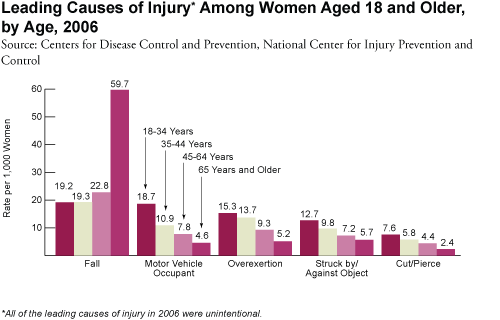
2. "DV is the leading cause of injuries to women between the ages of 15-44 in the U.S." (It's also a proven fact that the moon is made of Swiss cheese and the 9/11 attacks were masterminded by the CIA.)

3. Even if the violence is mutual, it's bad to arrest both parties because the "batterer gains more power." (Don't ask to see the research. I'm the one with the mic and I'll give you the boot if you start to ask questions.)

Then the curriculum goes on to enumerate the types of violence that it whimsically classifies as defensive:

1. Face scratches
2. Eye gouges
3. Bites to arm

Go ahead, ladies, scratch his face and gouge his eyes out. You can always say it was in self-defense — and now they'll have to take you at your word.

Patrick Henry College professor Stephen Baskerville has recently issued a stunning indictment of our contemporary criminal justice system, lambasting it as a "Feminist Gulag." Now in Maine, a man can be killed in cold blood without consequence to the perpetrator, prosecuted for rape with the flimsiest of evidence, or framed in a partner dispute on account of his sex.

And whatever happened to the equal protection clause of the U.S. Constitution?

© Carey Roberts


http://www.renewamerica.com/columns/roberts/100201

Friday, February 5, 2010

In OZ ~ Misconceptions that are depriving children of their fathers

From: Mike Murphy
 

Date: 5 February 2010 23:49
 

Subject: Misconceptions that are depriving children of their fathers * Angela Shanahan * 

From: The Australian * February 06, 2010 12:00AM
 

To: letters@theaustralian.com.au  

Dear Editor:

re: Misconceptions that are depriving children of their fathers
http://www.Australian.com.au/news/opinion/misconceptions-that-are-depriving-children-of-their-fathers/story-e6frg6zo-1225827005377
 
Beyond the shadow of a doubt this is the most balanced article I have seen in over two years of feminist agitating and MSM hysteria  over the shared parenting laws and mirrors my own observations.

I note the author does mention the case of the mom who jumped off the bridge with her child which gets nary a mention in the OZ MSM but the man's horrendous act sparked the eunuch Chisholm's inquiry.


Congratulations for finding some truth and shattering some of the mythology.

Mike Murphy


Angela Shanahan   February 06, 2010 12:00AM 


Shared parenting by separated couples is not a perfect solution but that's no reason to scrap it 


TWO stories last week resonated with a familiar timbre, that of shrill feminists yelling for men's blood. The first was the hysterical reaction to Tony Abbott's Women's Weekly interview in which he expressed his opinion on what is both a father's right and duty; the moral education of his children .

The second story has a similar thread running through it, with much graver implications. It concerns shared parenting by separated or divorced couples, which was a basis for family law reforms in 2006. According to some commentators, it is a failed experiment.

The reaction is puzzling since it goes against a supposed feminist notion of equality: that fathers and mothers have equal responsibilities and roles in their children's upbringing.

This story has been building for almost a year and, depending on what you read, shared parenting is (according to this newspaper) "on the way out" or to be "rolled back" or "brings little change". According to The Sydney Morning Herald: "Shared care failed children."

Adding fuel to this is a report by Richard Chisholm and a psychologist, Jennifer McIntosh, that concludes the reforms of 2006 have not benefited children, especially in acrimonious situations, which one might have thought was obvious.

Since only 16 per cent of parents practise shared parenting -- and, according to the Australian Institute of Family Studies, most arrangements work well -- one wonders what Chisholm is talking about. To work well, they must be non-acrimonious.

But there is more. According to Chisholm many parents -- read mothers who still are the main carers of children post-separation -- are being "coerced" into shared arrangements by fear, and by a presumption on the part of the father that shared parenting equals 50-50 shared time.

According to Chisholm, an unacceptable number of children in court-mandated shared care are exposed to unnecessary levels of acrimony and possible violence.

However the legislation is clear that where shared care has been ordered by a court, the presumption of shared care is dependent on there being no violence; putting a child into a possibly violent situation contradicts the law. So what is all this about about?

Shared care and domestic violence are separate issues. Children should not be exposed at any level. But there is definitely a risk of violence to children due to family breakdown and not simply from the father, but from the mother and other males.

None of this bothers those who want the 2006 reforms abolished. For them mothers must have autonomy even at the expense of a child's relationship with its father. They see a way to this amid Labor's ascendancy.

Single-mothers' groups such as the National Council for Children Post-Separation, backed by feminists and some journalists, have deliberately muddled the two issues of violence and shared care.

Chisholm recommends extensive dismantling of the 2006 reforms. In doing so, he seems to have exceeded his terms of reference, which were strictly limited to inquiring into matters before the federal Family Court in which issues of family violence arise.

According to Richard Egan of Family Voice Australia, "Chisholm proposes radical changes that could profoundly affect all separating couples with children, not just those where family violence is an issue. The report proposes removing the qualifiers `equal' and `shared' from the key provision introduced by the 2006 reforms. These provisions affirm as a fundamental presumption of family law `that it is in the best interests of the child for the child's parents to have equal shared parental responsibility for the child'.

"Chisholm's recommendation would see this key provision reduced to the meaningless statement that both parents are presumed to have `parental responsibility', but not necessarily in equal measure."

As for 50-50 time, Attorney-General Robert McClelland has repeated Chisholm's claim that it is an erroneous concept in practice. ". . . Regrettably, there have been instances where people have resolved cases, settled cases, on the assumption that the law intends an equal split of time."

But the law does require the courts, when proposing to make orders for equal responsibility, to consider making an order to provide for the child to spend equal time with each of the parents, if this is considered to be practicable and in the child's best interests.

The AIFS reports that of those children whose parents separated between July 2006 and September 2008, one in three never stay overnight with their father and one in nine never see their father. That is an improvement on the situation prior to 2006.

Before 2006 there was a de facto presumption in favour of an "80:20 outcome" in which, usually, the mother was given care of the child for most of the time with the father being given care of the child for every second weekend and half of school holidays.

Chisholm's recommendations would only increase the incidence of practical fatherlessness already being experienced by too many Australian children, by depriving the court of any guidance favouring equal shared responsibility.

One suspects the claim some children in shared arrangements are unnecessarily exposed to domestic violence due to mothers being afraid to speak up is a sham to cover the number of false claims of such violence, which interestingly have dropped since 2006.

McClelland has said the catalyst for the Chisholm report was the death of little Darcey Freeman last year, allegedly at the hands of her father. According to this newspaper, her mother was intimidated into surrendering her.

Curiously the intimation is that only fathers who intimidate pose a risk. They don't. When Gabriela Garcia jumped off the same Melbourne bridge with her baby later last year, no one began an inquiry.

These deaths are tragedies, the product of despair and madness, not a catalyst for gender wars.

If we want to fix child abuse that is another issue. Mothers are more commonly perpetrators of child deaths than fathers, and boyfriends are six times more likely to be perpetrators of physical and sexual violence than biological fathers.

As Patrick Parkinson, a principal author of the reforms, has said, "In the past 30 years, we have sown the wind in the revolution in attitudes to sex, procreation and marriage. We are now reaping the whirlwind. The societal problems which this has caused are problems that no law can resolve." Family breakdown contributes to child abuse; shared care does not.

http://www.theaustralian.com.au/news/opinion/misconceptions-that-are-depriving-children-of-their-fathers/story-e6frg6zo-1225827005377